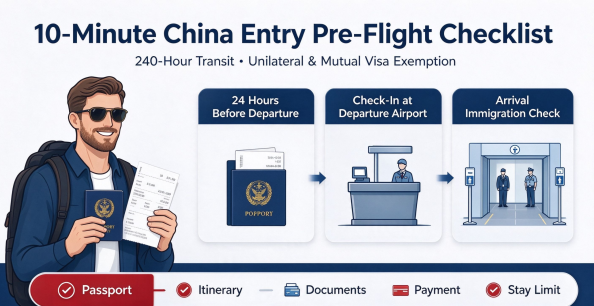
2026 Official Rules
Suitable for: Travelers entering China under the 240-hour visa-free transit policy, unilateral visa-free entry schemes, or mutual visa exemption agreements
Before You Start: Know Which Policy Applies
China’s visa-free rules vary significantly across schemes. This guide uses [240-Hour Transit Only] labels to mark requirements exclusive to transit travelers.
| 240-Hour Visa-Free Transit | Unilateral / Mutual Visa Exemption |
|---|---|
| Must transit through mainland China to a third country/region | No third-country onward ticket required for basic eligibility |
| Maximum stay: 240 hours (10 days) | Maximum stay: typically 15 or 30 days (varies by nationality) |
| Travel limited to permitted areas of 24 provincial-level regions | Access to most areas open to foreign visitors (controlled areas require separate permits) |
| A–B–C transit rule applies | No fixed itinerary structure requirement |
General Rule: Airlines and Chinese immigration authorities verify eligibility via official systems and document checks. Prepare both offline digital copies and printed documents. Do not rely solely on phone screenshots or unconfirmed bookings.
Stage 1: 24 Hours Before Departure
Document & Device Preparation
1. Passport & Travel Documents (All Travelers)
□ Confirm your passport meets the validity requirements of your applicable visa-free policy. A 6-month validity buffer is recommended as a prudent precaution. □ Verify you hold an eligible ordinary passport. Emergency travel documents, temporary passports, and damaged/altered documents may not qualify for visa-free entry. □ Prepare backups: Make 1–2 physical copies of your passport bio page and store them separately from the original. Save an offline electronic copy on your phone.
2. Itinerary Review
For All Travelers
□ Confirm all planned destinations are open to foreign visitors. If your itinerary includes Tibet or restricted border areas, check whether special permits are required — visa-free status does not automatically waive regional entry restrictions.
[240-Hour Transit Only]
Core eligibility rule: The country/region you arrive from (Point A) must differ from the country/region you depart to (Point C). In short: A ≠ C.
Connecting flights are allowed on both segments; nonstop flights are not required.
□ Confirm your itinerary satisfies the A ≠ C transit requirement
- ❌ Non-qualifying example: San Francisco → Shanghai → San Francisco (returning to the origin does not count as transit)
- ✅ Qualifying example: San Francisco → Shanghai → Hong Kong → San Francisco
- ✅ Qualifying example: London → Seoul → Shanghai → TokyoNote: Hong Kong, Macao and Taiwan have separate immigration systems from mainland China and may count as distinct destinations for transit purposes.
□ Verify both your entry and exit ports appear on the official designated port list. Open-jaw itineraries (e.g. enter Shanghai, depart Guangzhou) are permitted if both ports qualify. □ Confirm your total stay will not exceed 240 hours (10 days). The stay period starts at 00:00 on the day after arrival, not at your exact flight landing time.
3. Print Essential Documents
For All Travelers
□ Hotel booking confirmations: Guest name must match passport; include the hotel’s English address and phone number. At minimum prepare your first night booking; full-stay confirmations speed up immigration checks. □ Simple English itinerary: Outline your planned destinations and approximate schedule to help officers understand your travel plans.
[240-Hour Transit Only]
□ Confirmed onward flight itinerary (B→C segment): Prepare an official itinerary receipt showing the ticket number, confirmed seat, and exact departure date/time. Standby tickets and open-dated tickets do not meet requirements.
4. Phone & Travel Essentials
Payments
□ Set up Alipay: Download the app and link an international Visa/Mastercard where supported. Mobile payment is widely accepted for dining, transport and daily purchases. □ Bring backup payment methods: Carry an international bank card (Visa/Mastercard/UnionPay) for hotels, malls and chain restaurants. Exchange a small amount of Chinese yuan cash for small shops and emergencies.
Navigation & Translation
□ Download a map app: Amap (Gaode Maps) or Baidu Maps (both offer English features); Apple Maps also works in mainland China. □ Install a translation app with an offline Chinese language pack (e.g. Baidu Translate, Google Translate).
Internet Access
□ Activate an eSIM or international roaming package for connectivity after landing. □ Note that some overseas websites and social media services are restricted on mainland China networks. Confirm service availability with your roaming provider and prepare a lawful alternative if needed.
Stage 2: At Your Departure Airport
Airline Check-In & Document Verification
Airlines use the TIMATIC travel document system to verify entry eligibility. Having documents ready reduces the risk of denied boarding.
For All Travelers
□ Inform the check-in agent which visa-free arrangement you will use to enter China. □ Cooperate with passport and itinerary document checks. □ Confirm your baggage arrangement: Whether baggage is checked through to your final destination depends on your airline, ticket and route — not your visa-free eligibility. You may still qualify for visa-free entry even if you need to collect and recheck baggage.
[240-Hour Transit Only]
□ Clearly state you are entering under the China 240-Hour Visa-Free Transit Policy. □ Present your printed onward flight itinerary for the B→C segment. □ If the agent is unfamiliar with the policy, show official English guidance from China’s National Immigration Administration (NIA).
Stage 3: After Landing in China
Step-by-Step Immigration Procedure
- Proceed to the Correct Immigration Channel □ 240-hour transit passengers: Follow signs for “240-Hour Visa-Free Transit” or “Temporary Entry Permit Application”. □ Other visa-free travelers: Use the standard channel for visa-exempt foreign visitors.
- Complete Forms & Biometric Collection □ Fill out the arrival card/entry information form (available via self-service terminal or paper form). You may be asked for your China contact details, accommodation address and onward flight information. □ Cooperate with fingerprint and facial image collection as required.
- Immigration Inspection □ Present all required documents:
- All travelers: Passport, completed entry form, accommodation details (if requested)
- 240-hour transit travelers: Add your confirmed onward flight itinerary □ Answer questions clearly and truthfully (officers typically ask about travel purpose, length of stay, accommodation and next destination). □ Confirm your permitted stay before leaving the counter:
- 240-hour transit: Verify the departure deadline on your temporary entry permit. Remember the stay starts at 00:00 the day after arrival.
- Other visa-free schemes: Check your entry stamp and confirm the permitted stay duration. Ask officers to clarify any discrepancies before you leave.
Quick Self-Check Table
| Check Item | Completed? | Key Requirement | Applies To |
|---|---|---|---|
| Passport validity | ☐ | Meets policy requirements; has blank pages for endorsements | All travelers |
| Itinerary eligibility | ☐ | 240-hour transit requires A ≠ C; not required for other schemes | Varies by policy |
| Entry/exit ports | ☐ | Both ports must be designated for 240-hour transit | 240-hour transit only |
| Printed documents | ☐ | Accommodation details; onward itinerary for transit travelers | All travelers (extra docs for transit) |
| Payment setup | ☐ | Mobile payment configured, with bank card + cash backup | All travelers |
| Travel area compliance | ☐ | Stay within permitted areas; obtain permits for restricted zones | Varies by itinerary/policy |
| Length of stay | ☐ | Do not exceed the maximum stay for your policy | All travelers |
5 Common Misunderstandings About China’s Visa-Free Rules
- Misunderstanding: Transit passengers can only travel within the region they entered. Clarification: The 240-hour policy allows travel across permitted areas in 24 provincial-level regions — it is not limited to single clusters like the Yangtze River Delta or Beijing-Tianjin-Hebei. For example, entering via Shanghai may allow travel to permitted destinations like Xi’an or Chengdu. Always verify the latest official area list before booking.
- Misunderstanding: Flights must be nonstop to qualify for 240-hour transit. Clarification: Connecting flights are acceptable. The key requirement is that your arrival origin and departure destination are different countries/regions — not that flights are nonstop.
- Misunderstanding: All visa-free travelers need an onward ticket to a third country. Clarification: A confirmed onward ticket is a core requirement only for 240-hour visa-free transit. Unilateral and mutual visa exemption schemes generally do not have this rule. Always check the specific conditions for your nationality.
- Misunderstanding: Visa-free entry allows unrestricted travel across all of mainland China. Clarification: The 240-hour transit policy limits travel to designated areas. Destinations like Tibet and some border regions require additional permits, regardless of your visa status.
- Misunderstanding: The 240-hour stay starts when your flight lands. Clarification: Under standard policy calculation, the stay period begins at 00:00 on the day after arrival. It is not counted from your exact landing time. Always confirm your deadline with immigration authorities and depart before your authorized period expires.
Official Information & Assistance
- National Immigration Administration (NIA) English website: China National Immigration Administration
- Immigration service hotline (mainland China): 12367
Important Notice: Visa-free eligibility, permitted travel areas, designated ports and entry procedures are subject to change. Airlines may also conduct document checks before boarding. Always consult the latest official guidance before departure. Final entry decisions are made by Chinese border inspection authorities.