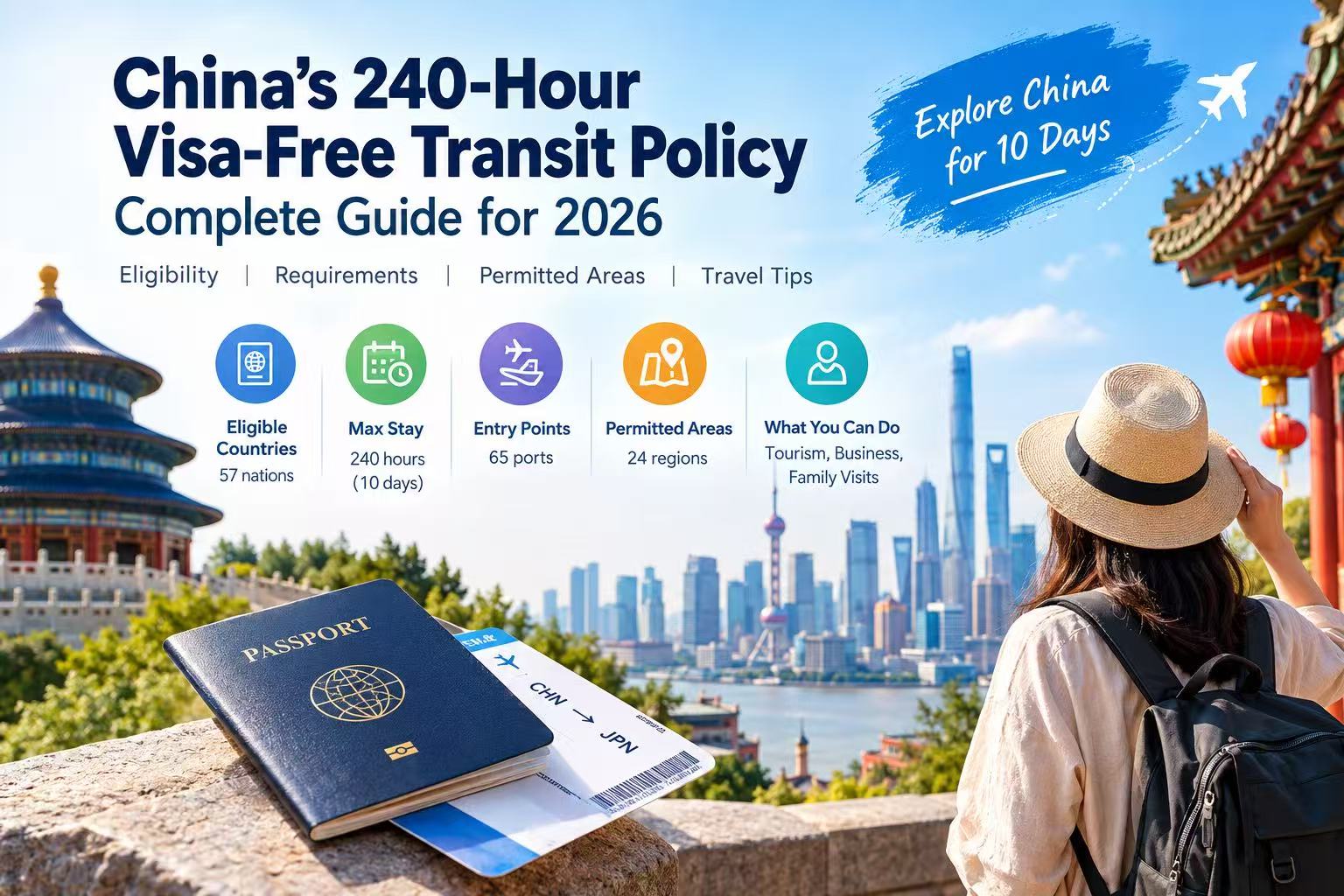
China’s 240-Hour Visa-Free Transit Policy: A Complete Guide for 2026
Updated per official regulations from the National Immigration Administration · August 2026
For international travelers planning to visit China in 2026, the country’s visa-free transit policy has undergone significant expansion and improvements. In late 2024, the permitted transit period was extended from 144 hours to 240 hours (10 days). The policy now covers citizens of 57 countries, 24 provincial-level regions, and 65 designated ports of entry.
Eligible travelers can visit permitted areas of China for short-term activities, including tourism, business visits, and family visits, without applying for a regular Chinese visa. This means fewer administrative steps and no visa application fees.
However, it is important to understand that the policy comes with strict legal requirements. If your itinerary does not meet the eligibility criteria, you could be denied boarding or refused entry into China.
This guide, prepared by ChinaEntry Pro, is designed to explain the key requirements in clear, accessible language, based on official regulations. Use it to plan your trip with greater confidence and prepare for a smoother arrival in China.
1. Eligibility: Do You Qualify?
The policy applies only to ordinary passport holders from the 57 eligible countries listed below. Holders of diplomatic, service, official, or other special passports are not eligible under this specific transit visa exemption policy.
Full List of the 57 Eligible Countries
| Region | Included Countries |
|---|---|
| Europe (40 countries) | Albania, Austria, Belarus, Belgium, Bosnia and Herzegovina, Bulgaria, Croatia, Cyprus, Czechia, Denmark, Estonia, Finland, France, Germany, Greece, Hungary, Iceland, Ireland, Italy, Latvia, Lithuania, Luxembourg, Malta, Monaco, Montenegro, the Netherlands, North Macedonia, Norway, Poland, Portugal, Romania, Russia, Serbia, Slovakia, Slovenia, Spain, Sweden, Switzerland, Ukraine, the United Kingdom |
| The Americas (6 countries) | Argentina, Brazil, Canada, Chile, Mexico, the United States |
| Oceania (2 countries) | Australia, New Zealand |
| Asia (9 countries) | Brunei, Indonesia, Japan, Kyrgyzstan, Qatar, Singapore, South Korea, the United Arab Emirates, Vietnam |
Basic Entry Requirements
To qualify, travelers must meet all of the following conditions:
- Their ordinary passport must be valid for at least 3 months from the date of entry into China.
- They must not be subject to a current entry ban imposed by China.
- They must have no record within the past 5 years of violations such as illegal entry, illegal residence, or illegal employment in China.
2. The Core Rule: You Must Be Transiting to a Third Country or Region
This is one of the most frequently misunderstood requirements, and one of the most common reasons travelers may be denied entry.
Eligible Itinerary Logic
Country/Region of Departure → China (Transit Stop) → A Third Country/Region
The following rules apply:
- Your country/region of departure and your final destination must be different. A round-trip itinerary that returns you to your original country does not qualify as transit under this policy.
- Hong Kong SAR, Macao SAR, and Taiwan are treated as separate destinations for the purposes of this transit requirement.
Valid Itinerary Examples
- London → Shanghai → Tokyo
- New York → Beijing → Hong Kong
- Sydney → Guangzhou → Hanoi
Invalid Itinerary Examples
- London → Shanghai → London
Returning to the same country of departure constitutes a round trip rather than qualifying transit. - Paris → Chengdu → Paris
Returning to your original destination does not meet the third-country/region requirement.
Official requirement: Your confirmed onward ticket to a third country/region must include a confirmed seat and departure date. Your departure must take place within the permitted 240-hour stay.
3. Required Documents for Entry
Upon arrival at a designated port of entry, you must apply to border inspection authorities for a temporary entry permit. Prepare the following documents before your trip.
Mandatory Documents
- Valid ordinary passport
Issued by one of the 57 eligible countries, with at least 3 months of remaining validity. - Confirmed onward ticket
A confirmed ticket to a third country/region, with a reserved seat and departure date falling within the 10-day permitted stay. - Temporary Entry Card for Foreigners
The blue arrival card that must be completed when applying for temporary entry. It is available free of charge at all designated entry ports.
Supporting Documents (May Be Requested)
Border inspection officers may request additional evidence of your planned stay, depending on the circumstances. Examples include:
- Hotel booking confirmations
- Official invitation letters
- Other documents supporting the purpose and arrangements of your visit
Preparing these documents in advance can help reduce delays during the entry inspection process.
4. How the 240-Hour Stay Is Calculated
This is one of the most easily misunderstood aspects of the policy, particularly for first-time visitors to China.
Key Rule: The 240-hour period begins at 00:00 on the day following your arrival, rather than at the actual time you land.
Calculation Example
Suppose you enter China on October 1:
- Your permitted stay begins at 00:00 on October 2.
- Under this calculation method, your latest departure time is 23:59 on October 11.
Do not simply add 240 hours to your landing time when calculating your departure deadline. Doing so could lead to an overstay and potential legal penalties.
Official calculation tool: You can verify your latest allowed departure date with the 240-hour visa-free transit calculator:
http://22baike.com/visa-calculator/Important: Always verify the applicable deadline with border inspection authorities, particularly if your itinerary involves overnight flights or a change of departure date.
5. Arrival Procedures: A Step-by-Step Guide
After arriving at a designated port — such as Shanghai Pudong (PVG), Beijing Capital (PEK), Guangzhou Baiyun (CAN), or Chengdu Tianfu (TFU) — follow these general steps.
- Find the designated immigration channel
After leaving the aircraft, follow the signs for “240-Hour Visa-Free Transit” or the equivalent designated immigration channel, and proceed to the appropriate border inspection area. - Complete the arrival card
Obtain the blue Temporary Entry Card for Foreigners at the service counter and fill it out accurately. - Present your documents
Show the border inspection officer your passport, confirmed onward ticket, and completed arrival card. Answer any questions and provide additional documentation if requested. - Complete biometric checks
Depending on local procedures, you may be asked to provide fingerprints and a facial image at an automated kiosk or staffed counter. - Receive your temporary entry authorization
If approved, the officer will issue the relevant temporary entry authorization, which may take the form of an endorsement or permit sticker in your passport. - Clear customs
Collect your checked baggage and proceed through customs inspection before entering the city.
Legal requirement: Foreign nationals must complete accommodation registration within 24 hours of arrival. Hotels generally handle this on your behalf. If staying in a private residence, your host must arrange registration with the local police station.
6. Where Can You Travel? Permitted Geographic Areas
The 240-hour visa-free transit policy does not restrict you to the city where you enter China. Eligible travelers may visit permitted areas across all 24 participating provincial-level regions. You may enter through one designated port and depart through another, as long as both ports are covered by the policy.
Full Provincial Access (18 Provinces/Municipalities)
You may travel freely throughout the full administrative boundaries of: Beijing, Tianjin, Hebei, Liaoning, Shanghai, Jiangsu, Zhejiang, Anhui, Fujian, Shandong, Henan, Hubei, Hunan, Guangdong, Hainan, Chongqing, Guizhou, Shaanxi
Partial City Access (6 Provinces/Regions)
Travel is limited to the designated cities/prefectures listed below:
- Shanxi: Taiyuan, Datong
- Heilongjiang: Harbin
- Jiangxi: Nanchang, Jingdezhen
- Guangxi: Nanning, Liuzhou, Guilin, Wuzhou, Beihai, Fangchenggang, Qinzhou, Guigang, Yulin, Hezhou, Hechi, Laibin (12 cities total)
- Sichuan: Chengdu, Leshan, Deyang, Meishan, Ya’an, Ziyang, Neijiang, Zigong, Luzhou, Yibin, Suining (11 cities total)
- Yunnan: Kunming, Lijiang, Dali, Honghe, Xishuangbanna, Dehong, Baoshan, Pu’er, Lincang (9 cities/prefectures total)
Regions Not Covered by the Policy
The following 7 provincial-level regions are not included in the policy: Inner Mongolia, Jilin, Tibet, Gansu, Qinghai, Ningxia, Xinjiang
Before booking intercity transportation, always confirm the latest official list of permitted areas and ports of entry/exit.
7. Permitted & Prohibited Activities
Permitted Activities
The policy allows short-term, non-work activities including:
- Tourism and sightseeing: Exploring cities, visiting attractions, and leisure activities
- Business visits: Attending meetings, trade negotiations, and other permitted business activities
- Family and personal visits: Visiting relatives and friends, or handling personal matters
Prohibited Activities
The transit exemption does not replace visas for other purposes. You must obtain the appropriate visa/authorization in advance for:
- Any form of paid or unpaid employment/work requiring work authorization
- Full-time/part-time study, formal training, or internships requiring a relevant visa
- Journalistic assignments and media reporting
- Any other activity requiring prior official approval
If your primary purpose is employment, study, or another visa-required activity, do not use the 240-hour transit policy.
8. Practical Tips for a Smooth Visit in 2026
- Carry printed copies of key documents
Print your onward flight itinerary and hotel booking confirmations before departure. Paper copies avoid issues from dead phone batteries, lost internet access, or officer requests for physical documentation. - Confirm your departure port is eligible
Before booking your onward flight, verify that your departure port is on the official designated list. Not every airport or border crossing in a participating province is eligible. - Set up mobile payments before arrival
Alipay and WeChat Pay are widely accepted for taxis, restaurants, shopping, and public transit. You can link an eligible international bank card ahead of your trip for greater convenience. Keep an alternative payment method as backup. - Keep your passport accessible at all times
Your passport and temporary entry authorization are legal proof of your lawful stay. Keep them secure and handy when traveling between cities or checking into accommodation. - Use official channels for policy questions
For eligibility, permitted activities, or latest immigration updates, contact the National Immigration Administration via its 12367 service hotline, which offers multilingual support in English, Japanese, Korean, and Russian.
Frequently Asked Questions
Can I enter through Shanghai and depart from Guangzhou?
Yes, as long as both ports are covered by the policy, your itinerary meets the transit requirements, and you stay within permitted areas. You may also travel between participating provincial-level regions during your stay.
What happens if I overstay the 10-day limit?
Overstaying may violate China’s immigration laws and regulations. Depending on the circumstances, penalties may include fines, detention, or future entry restrictions. Always allow buffer time to reach your departure port and complete exit procedures.
Can I change my onward flight after entering China?
Changes are acceptable if your revised itinerary still meets all policy requirements: the 240-hour time limit, an eligible departure port, and the third-country/region transit rule. For major itinerary changes, consult local immigration authorities first.
Does the policy apply to land and sea ports, not just airports?
Yes. The policy covers designated ports across air, sea, and land transportation modes, with 65 ports distributed across the 24 participating regions. Not every crossing is eligible — confirm the official list before finalizing your plans.
Ready to Start Planning Your 10-Day Trip to China?
You don’t need to let immigration paperwork overshadow your travel plans. We’ve prepared a 240-Hour Visa-Free Transit Pre-Departure Checklist to help you verify your itinerary, organize required documents, and prepare for each stage of the arrival process.
You can also use the online transit calculator to double-check your allowed stay period in advance:
http://22baike.com/visa-calculator/
Use the checklist and calculator before departure to identify potential issues early and make your journey to China as straightforward as possible.
Disclaimer
This guide is for general informational purposes only and is based on official policy information available as of August 2026. Immigration rules and implementation procedures are subject to change. For the most authoritative and up-to-date requirements, consult official announcements from the National Immigration Administration of China before traveling.