Planning a trip to China but unsure whether you need a visa? China’s 240-hour visa-free transit policy allows eligible ordinary passport holders from 57 countries to stay in designated areas of China for up to 10 days while transiting to a third country or region.
Under this policy, eligible travelers can explore cities such as Beijing, Shanghai and Chengdu without applying for a regular visa. However, eligibility depends on your nationality, travel documents, itinerary and the areas you plan to visit.
This guide explains the key rules, common misconceptions and practical steps to take before booking your trip.
Last updated: October 2026. Always check the latest official requirements before departure.
1. What Is China’s 240-Hour Visa-Free Transit Policy?
China’s 240-hour visa-free transit policy allows eligible international travelers to enter China without a visa while transiting to a third country or region.
As of August 20, 2026, the policy covers:
- 57 eligible countries
- 65 designated entry and exit ports
- 24 provincial-level administrative regions
- A maximum stay of 240 hours (10 days)
During their stay, travelers may engage in permitted activities such as tourism, business visits, and visiting family or friends. Activities requiring prior official approval, including employment, full-time study and journalistic reporting, are not permitted under this visa-free transit policy.
Important note: This is a visa-free transit policy, NOT a general visa-free entry policy. You must meet the transit requirements and remain within the areas permitted under the policy. Official source: China’s National Immigration Administration (NIA).
2. Eligibility and Requirements
You must meet all of the following conditions to qualify for this policy:
- Hold a passport issued by an eligible country The policy currently covers 57 countries, including the United States, the United Kingdom, Canada, Australia, New Zealand, Japan, South Korea and Singapore. Kyrgyzstan and Vietnam were officially added on August 20, 2026.
- Hold a valid ordinary passport According to official requirements, your passport must have at least three months of remaining validity.
- Have confirmed onward travel arrangements You must be travelling onward from China to a third country or region, with a confirmed connecting ticket showing a fixed departure date and confirmed seat, or other valid travel documentation accepted under the policy.
- Enter and exit through designated ports Both your entry port and departure port must appear on the official list of approved ports.
- Stay only within the permitted areas Not every city or tourist attraction in China is covered. Before finalising your itinerary, review the official list of areas open to visa-free transit visitors.
Disclaimer: Meeting these conditions does not guarantee entry. The final entry decision rests with the competent immigration authorities.
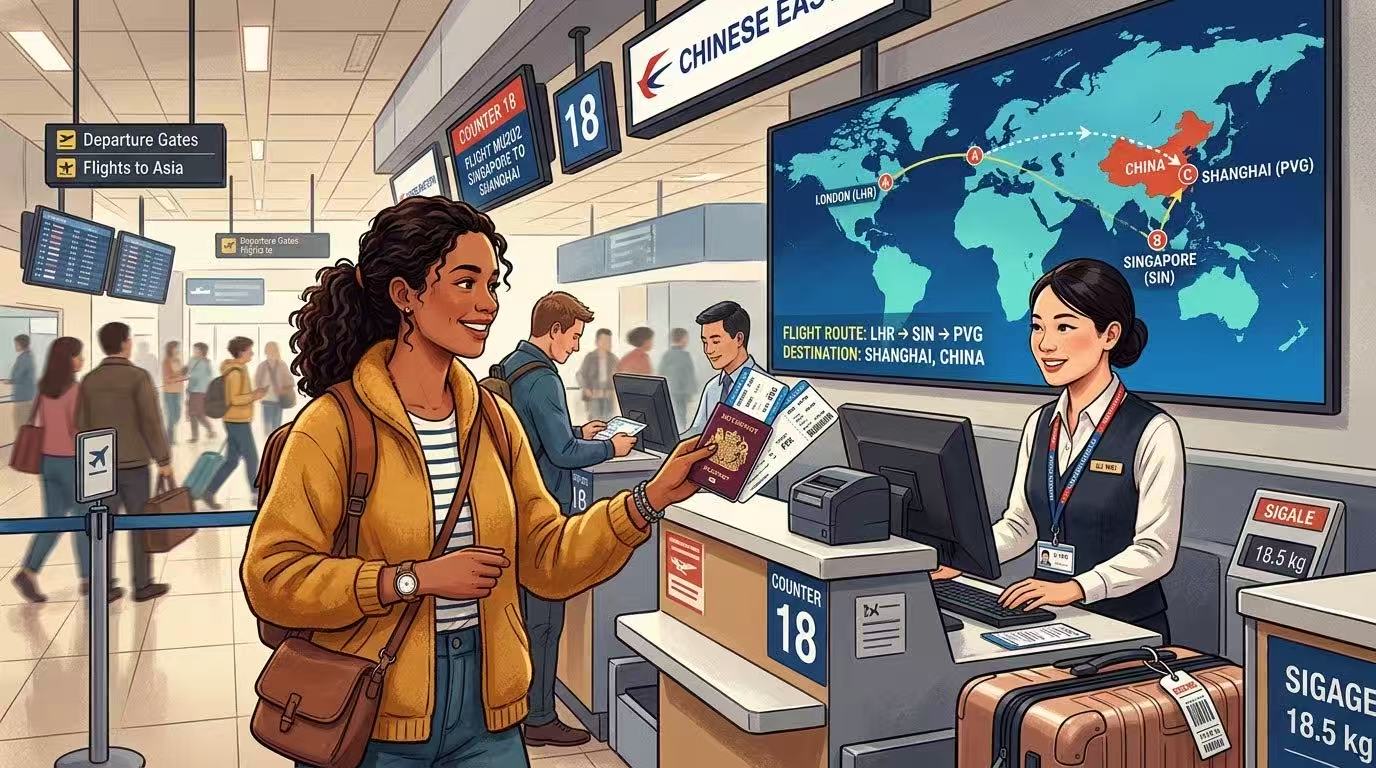
3. What Is the A-B-C Transit Rule?
The “A-B-C Rule” is an easy-to-understand summary of the transit requirement. It is an informal explanation and not an official legal term.
- A = Your place of departure: The country or region you leave immediately before arriving in mainland China
- B = China: Your transit stop
- C = A third country or region: Your next destination after leaving China
✅ Valid example: London → Shanghai → Tokyo This itinerary satisfies the basic transit pattern, provided all other eligibility rules are met.
❌ Invalid example: London → Shanghai → London This does not qualify, as you are not transiting onward to a different third country/region.
Core principle: Your trip must be genuine transit through China to another country or region.
Tip: Do not rely solely on the A-B-C concept for complex multi-ticket or separately booked itineraries. Double-check official rules before travel.
4. Can You Visit Multiple Cities in China?
Yes. Within the approved zones across the 24 participating provincial-level administrative regions, cross-city and cross-province travel is allowed. You may enter via one designated port and depart via another, as long as both ports are authorised and your itinerary complies with all policy terms.
⚠️ Key reminder: Access is limited to officially defined permitted zones. Having an airport does not automatically mean a city is open under this scheme.
Before booking hotels or domestic transport, confirm all of the below:
- Your planned destinations fall inside permitted transit areas
- Your entry and exit ports are official designated ports
- Your whole itinerary meets the transit rules
- Your entire visit fits within the 240-hour time limit
Example: Entering via Shanghai does not give you free rein to travel anywhere across mainland China. For multi-province, split-ticket or complicated connecting journeys, confirm details with your airline and the National Immigration Administration before departure.
5. How Is the 240-Hour Stay Period Calculated?
The allowed stay window is not calculated by adding 240 hours to your flight landing time.
Official calculation rule: The visa-free stay period starts at 00:00 on the day after your entry date.
Example: If you enter China on October 10 → Your valid stay window starts at 00:00, October 11 → You must depart by 23:59, October 20
This timing rule is critical. Arriving late at night does not grant you an extra full day. Build buffer time into your schedule to handle unexpected travel delays.
6. Common Mistakes to Avoid
- ❌ Mistake 1: Assuming all nationalities are eligible This transit scheme only applies to passport holders from listed countries. China runs separate visa exemption programmes with different criteria.
- ❌ Mistake 2: Thinking you can visit any city once you have booked an itinerary This policy does not grant unrestricted nationwide travel. You must stay inside authorised zones.
- ❌ Mistake 3: Believing any onward ticket will work Your outbound travel must satisfy transit rules. Keep your confirmed itinerary handy for airline check-in and immigration inspection.
- ❌ Mistake 4: Mixing up visa-free transit and regular visa-free entry China has multiple visa waiver arrangements. Qualifying for one scheme does not mean you qualify for others.
7. Plan Your China Transit Trip
Once you confirm your eligibility and permitted travel zones, you can start arranging your trip. Consider these items in advance:
- Accommodation: Compare hotels near airports, high-speed railway stations or major attractions
- Domestic transport: Research high-speed trains, airport shuttles and local transit options
- Tours & activities: Select guided city tours or day trips located within permitted areas
- Travel essentials: Prepare for internet access, payment methods and other practical logistics
Before booking, compare options and review cancellation policies, journey durations, and exact locations for hotels and activities.
8. Final Pre-Departure Checklist
Use this checklist before travelling under the 240-hour visa-free transit policy: ✅ Your nationality is on the eligible country list ✅ Your passport meets the validity requirement ✅ Your onward ticket and itinerary satisfy transit rules ✅ Entry and exit ports are both designated ports ✅ All planned destinations lie within permitted stay areas ✅ Arrival and departure dates comply with the 240-hour limit ✅ You have reviewed the latest official notices
Official Links
- Full policy guide: https://en.nia.gov.cn/n147418/n147463/c183412/content.html
- Latest announcement for eligible countries: https://en.nia.gov.cn/n147418/n147468/c217849/content.html
Policy provisions, country lists and permitted travel zones are subject to change. Always check the latest guidance published by China’s National Immigration Administration before departure.
General disclaimer: This article is for informational purposes only and does not guarantee entry into China. If your itinerary is complicated or you are uncertain about eligibility, contact your airline or relevant Chinese immigration authorities before you travel.
✈️ China 144-Hour Visa-Free Route Checker
OFFICIAL RULESCheck if your flight itinerary satisfies the $A \neq C$ non-stop transit rule.
✅ ELIGIBLE FOR 144-HOUR VISA-FREE TRANSIT
Valid A-B-C route! Point A and Point C belong to legally distinct countries/territories.
*Official Rules Note: 1. Point A and C are defined by direct flight legs (layovers without border clearance do not count). 2. Travel within China must remain within your entry port's designated administrative cluster. 3. You must hold a confirmed onward ticket and passport from one of the 54 eligible countries.